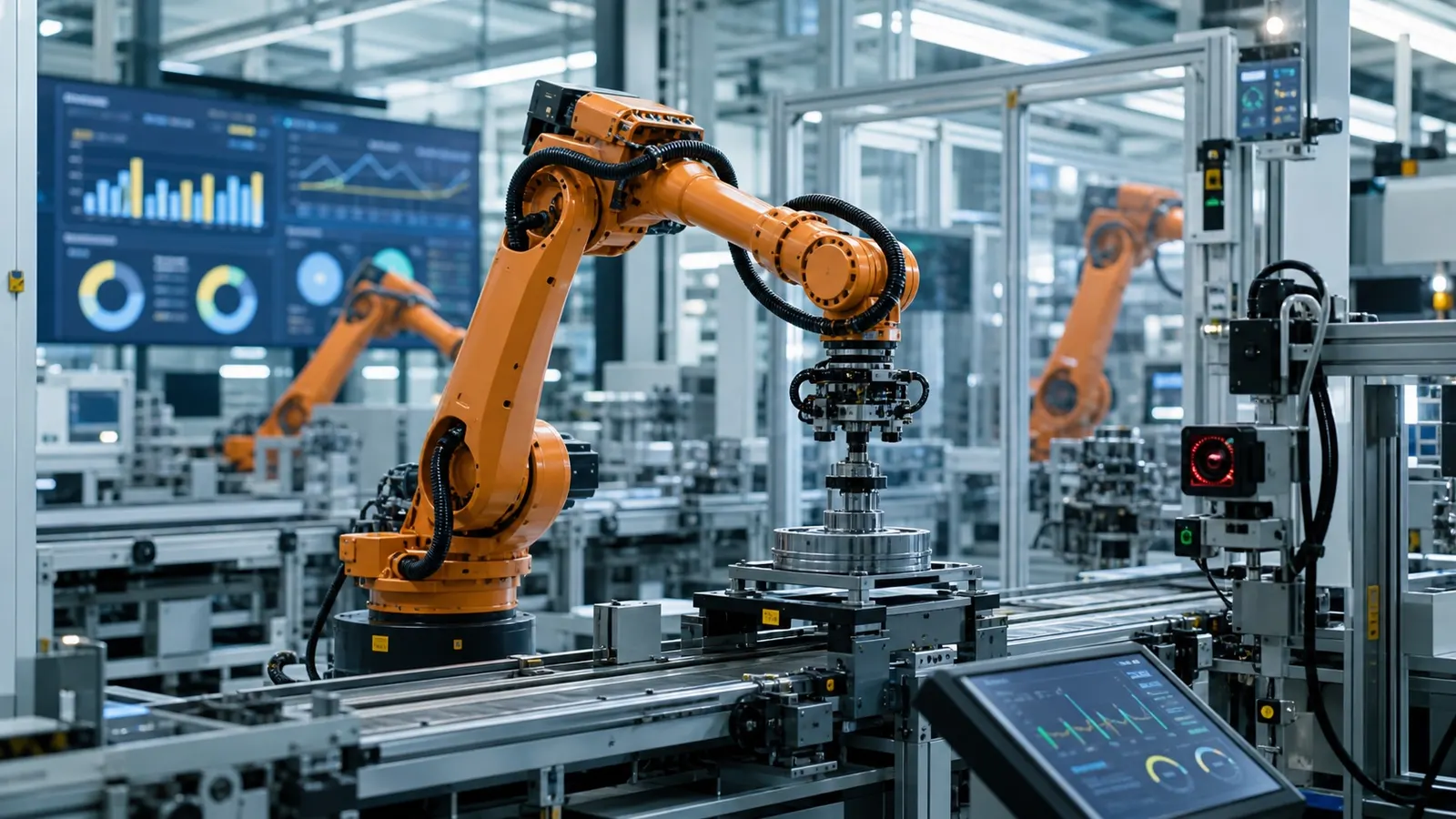
The quick answer: collaborative robots for small manufacturers are most useful when they automate one narrow, repetitive task with clear part flow, simple fixtures, and measurable labor or quality pressure. In 2026, cobots are not magic factory workers. They are flexible robot arms that can help with machine tending, light assembly, packaging, inspection, sanding, dispensing, palletizing, and welding support when the process is already reasonably stable.
This post contains affiliate links. We may earn a small commission at no extra cost to you.For small and mid-size manufacturers, the buying question is not "Should we automate?" It is "Which task can pay back without turning the shop into a systems integration project?" That is where cobots still make sense. They sit between manual labor and traditional fenced industrial automation: easier to redeploy, usually simpler to program, and often more realistic for short-run production.
Why Cobots Fit Smaller Shops
Traditional industrial robots were built for high-volume production lines. They are fast, repeatable, and powerful, but they usually require guarding, fixed workflows, and specialist integration. Small manufacturers often do not have that kind of volume or engineering staff.
Cobots are slower, but that is part of the point. Built-in force limiting, hand-guiding, simpler programming tools, and smaller footprints make them easier to place beside existing equipment. The International Federation of Robotics notes that collaborative robots reached 10.5% of industrial robot installations worldwide in 2023, which is still a minority share but no longer a niche experiment: IFR on collaborative robots.
The practical advantage is redeployment. A cobot that tends a CNC machine this quarter may handle inspection or packaging later if the business changes. That flexibility matters more for a 40-person job shop than peak cycle speed.
For broader sector context, compare this with our industrial automation robotics investor guide, where the same theme appears at larger scale: adoption follows workflows with obvious bottlenecks, not demo-stage excitement.
Best First Use Cases
The strongest first cobot projects share three traits: the part is predictable, the task is repetitive, and the success metric is obvious.
Machine tending is the classic example. A cobot loads blanks into a CNC, press brake, injection molding machine, or test fixture, then removes the finished part. The robot does not need to understand the whole factory. It just needs consistent part presentation and reliable grippers.
Packaging and palletizing are also good candidates. End-of-line labor is often hard to staff, and the motion pattern is repetitive. Small palletizing cobots can handle cases, cartons, and totes without the footprint of a full palletizing cell.
Light assembly, screwdriving, adhesive dispensing, and inspection can work too, but they need more process control. If the parts vary wildly or the fixture is sloppy, the robot will expose that weakness. A cobot does not fix a messy process; it makes the mess repeatable.
Useful starter gear usually includes a robot arm, gripper, stand, safety scanner if needed, and simple vision or fixtures. For research and training, teams often start with books and lab-scale kits before committing to a production cell: collaborative robot books, robot grippers, and machine vision lighting.
Cost, Payback, and Hidden Work
A small cobot cell can look inexpensive on a brochure and still become expensive in the plant. The arm is only one line item. Grippers, pedestals, fixtures, guarding, scanners, programming, installation, training, and downtime all matter.
The cleanest projects usually pay back in 12 to 36 months. If the spreadsheet needs heroic assumptions, the project is probably too early. Start with the labor hours currently consumed, scrap rate, overtime pressure, recruiting difficulty, and machine utilization. Then subtract realistic downtime, maintenance, and engineering support.
The hidden cost is ownership. Someone inside the company needs to understand the cell well enough to restart it, adjust recipes, swap tooling, and know when to call the integrator. Without that owner, the cobot becomes an expensive monument after the first process change.
Small shops should ask vendors for proof of similar deployments, not generic productivity claims. A good vendor can show how the robot handles part presentation, changeovers, operator training, and failure recovery.
Safety and Vendor Shortlist
"Collaborative" does not automatically mean "safe in every setup." Safety depends on the application, tool, speed, payload, workpiece, pinch points, and the human traffic around the cell. A cobot holding a sharp part, hot component, or heavy tool can still hurt someone.
Universal Robots remains the category reference point. FANUC, ABB, Yaskawa, Doosan, Techman, Kassow, and several Chinese vendors all compete aggressively. The right shortlist depends less on brand romance and more on local support, payload, reach, software comfort, end effector ecosystem, and integration partners.
For many small manufacturers, the integrator is more important than the arm. A mediocre plan with a great robot still fails. A disciplined integrator with a mainstream cobot platform can build something maintainable.
FAQ
Are collaborative robots worth it for small manufacturers?
Yes, when the first task is narrow, repetitive, and easy to measure. They are least worth it when the shop expects a cobot to handle constantly changing, poorly fixtured work with no internal automation owner.
How much does a cobot cell cost in 2026?
The robot arm may be tens of thousands of dollars, but a production-ready cell can cost much more once tooling, fixtures, safety, programming, and integration are included. Always budget the whole cell, not just the arm.
Do cobots replace workers?
Sometimes they reduce manual hours on one task, but the better small-shop use case is usually machine utilization and labor leverage. The goal is to move people away from dull loading, unloading, and packing work toward setup, quality, maintenance, and higher-value production.
The bottom line: collaborative robots for small manufacturers work best when treated as practical automation tools, not humanoid substitutes. Pick one painful workflow, prove payback, train an internal owner, and only then expand to the next cell.