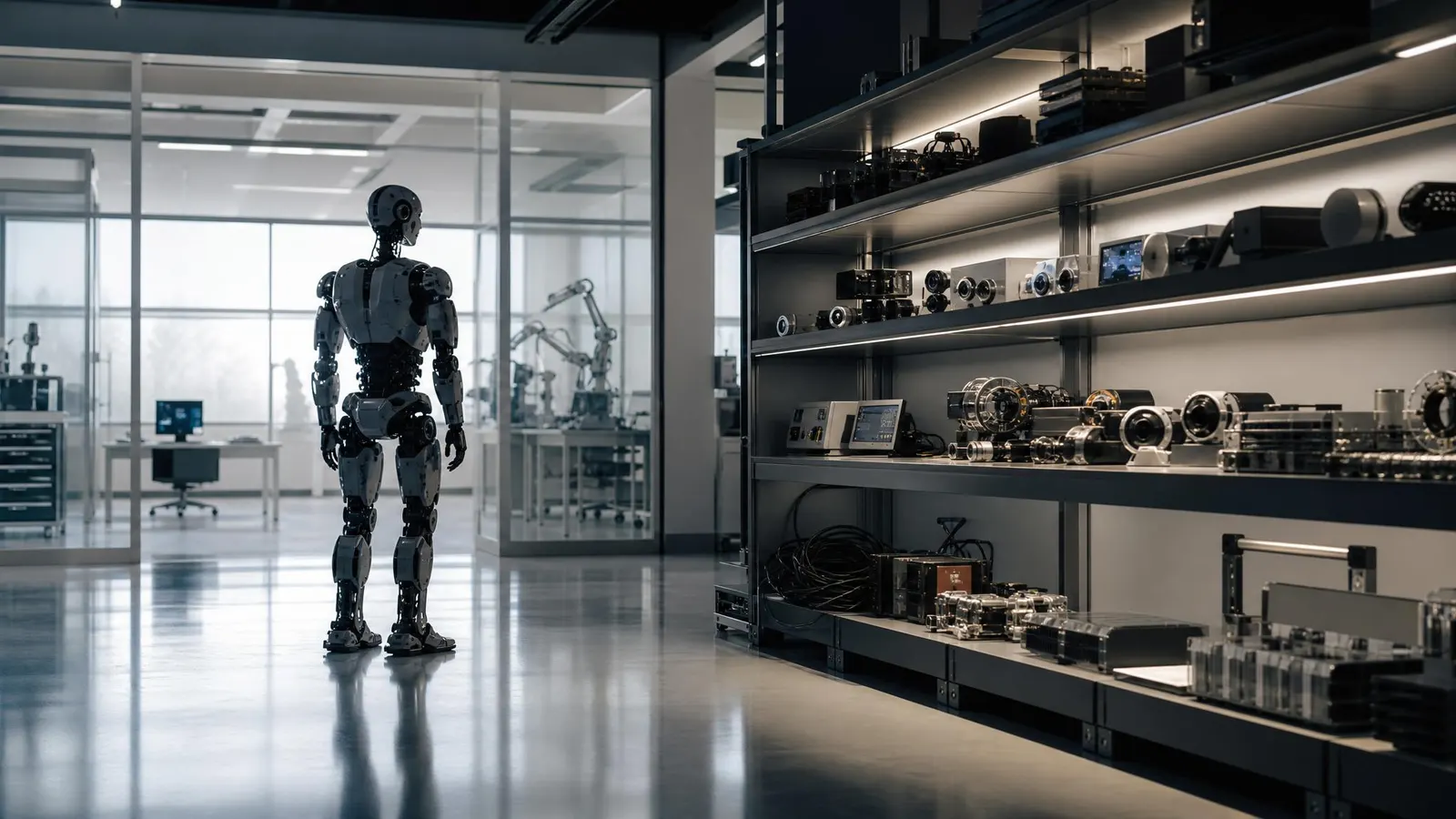
!A humanoid robot inspecting a server rack — symbolizing the convergence of AI and robotics capital
The single biggest investment narrative of 2026 is no longer "AI" in the abstract — it is embodied AI: the merger of large foundation models with mechanical systems that move, manipulate, and operate in the physical world. The capital chasing this convergence is enormous, the addressable markets are huge, and the timing question — now or wait? — is the single most-asked question in our inbox.
This is RoboBrief's pillar forecast for AI-driven robotics investment in 2026. We will not give you stock tips. We will give you the framework, the sector map, the sizing, and the durable signals that separate hype from genuine compounding. Bookmark this page — we update it quarterly.
The 2026 setup: why this cycle is different
Three previous robotics "moments" came and went without delivering durable returns: the late-2000s Roomba era, the 2014–2017 service-robot bubble (think SoftBank's Pepper), and the 2021 SPAC wave that listed a dozen pre-revenue robotics companies into the public market. Most of those names are now de-listed, in receivership, or trading at a fraction of issue.
What makes 2026 structurally different:
- Foundation models cracked manipulation. Until 2024, robots could perceive but couldn't generalize manipulation. Vision-language-action (VLA) models — Physical Intelligence's π series, Google DeepMind's RT-2, Tesla's Optimus stack — collapsed millions of training hours into a transferable skill base. We covered the latest leap in our Physical Intelligence π0.7 deep dive.
- Unit economics flipped. A humanoid bill of materials (BOM) that cost $250k in 2022 ships at sub-$25k from Chinese OEMs in 2026. We documented the $5,900 Unitree R1 hitting AliExpress — a price point that re-prices the entire labor-substitution math.
- Demand pull from the supply side. The US shipbuilding bottleneck, Chinese aging-population labor cliff, and post-COVID warehousing build-out all converged into actual purchase orders, not pilots. See our coverage of GrayMatter's AI shipbuilding deal and the warehouse automation surge.
The result: 2026 is the first year robotics revenue is rising faster than venture markup, which is the single most durable signal you can ask for.
Sector map — where the capital is actually flowing
Robotics is not one market. It's at least seven, with very different unit economics, capital intensity, and regulatory exposure. Here is the 2026 RoboBrief sector map, ranked by 2026 capital inflow.
| Sector | 2026 inflow (est.) | Best-in-class examples | Investment profile |
|---|---|---|---|
| Humanoid GP robots | $14B | Tesla Optimus, Figure, Physical Intelligence, Unitree | High-risk, generational upside |
| Industrial / cobots | $9B | Fanuc, ABB, Universal Robots | Steady, dividend-friendly |
| Warehouse automation | $7B | Symbotic, AutoStore, Skild AI / Fetch | High-growth, near-term cashflow |
| Surgical robotics | $6B | Intuitive Surgical, Stereotaxis, Medtronic | Reg-protected moat, slow but durable |
| AMRs (logistics) | $5B | Locus, Mobile Industrial, MiR | Mid-cycle, consolidating |
| Defense / unmanned | $4B | Anduril, Shield AI, Skydio | Geopolitically driven, lumpy |
| Service / consumer | $2B | iRobot, Ecovacs, Matic | Mature, low-margin, ad-supported |
A few observations that will shape your 2026 portfolio:
- Humanoid GP is taking the lion's share of new capital but the least of revenue. That gap is what makes humanoids the highest beta exposure in the sector.
- Surgical robotics is the only category where regulatory moats compound over time, hence the durable Intuitive Surgical re-rating.
- Defense robotics is suddenly liquid. Anduril's secondary tender at $30B+ valuation drew sovereign wealth and made unmanned-systems a real allocation, not a fringe.
- Warehouse automation is the "shovels and picks" — boring but cash-generative.
Public-market plays: the 2026 watchlist
Below are the names RoboBrief tracks across the seven sectors. None of this is a recommendation; do your own research and consider talking to a financial advisor before allocating capital. We pair each with what we are watching as the durable signal.
Industrial backbone
- Fanuc (TYO: 6954) — global cobot leader, 60% gross margins, balance sheet that buys downturns. Watch unit shipments, not pricing.
- ABB (NYSE: ABB) — diversified electrification + robotics, the "GE of robotics." Watch ABB Robotics organic growth.
- Rockwell Automation (NYSE: ROK) — picks-and-shovels for re-shoring; benefits from US CHIPS Act manufacturing buildout.
Pure-play growth
- Symbotic (NASDAQ: SYM) — Walmart anchor, expanding into Ahold and BJ's. Watch backlog conversion to revenue.
- Intuitive Surgical (NASDAQ: ISRG) — reference asset for what robotics-as-platform looks like long-term. Watch da Vinci 5 ramp and the Ottava / Hugo competitive landscape.
- Stereotaxis (NYSE: STXS) — small-cap surgical robotics, just acquired Robocath. Higher beta way to get surgical exposure.
Geopolitical exposure
- Estun (SHE: 002747) — Chinese cobot leader, riding the 187% IPO surge we covered. Higher risk, single-country exposure.
- Siasun (SHE: 300024) — Chinese industrial robot champion, beneficiary of state-backed robot army deployment in critical infrastructure.
Want to dive deeper into the fundamentals?
If you are starting from zero on robotics-as-asset-class, two books on our shelf earn their keep. The Robotic Economy by R.M. Patel — a clear walk-through of unit economics across the seven sectors above — is available on Amazon: The Robotic Economy. For the AI-side mental model, Embodied Intelligence by L. Han pairs well with the foundation-model section of this article: Embodied Intelligence.
Private capital and venture trends
2026 venture-stage robotics has bifurcated sharply.
The top-of-stack — humanoid GP, world models, robot foundation models — is white-hot, with rounds valued more like AI labs than industrial companies. Figure, 1X, Physical Intelligence, and Skild AI all completed >$500M rounds at >$5B post-money in the last twelve months. The mid-stack — application-layer robotics startups (food prep, last-mile delivery, agriculture) — is at a 30-40% discount to 2022 marks. The healthy ones are the ones with paying customers. Examples that crossed our desk: Chef Robotics surviving where competitors didn't, Coco x Uber Eats hitting $1 delivery economics. Stragglers and walking dead — Pepper-era service robotics, niche consumer plays without retention — keep hitting bridge rounds at flat or down marks. We expect a 2026–2027 wave of "soft" failures rolled into larger acquirers: see Skild AI acquiring Fetch Robotics as the template.For retail investors who can't access private markets directly, the cleanest proxy remains a globally diversified robotics ETF. Two of the larger ones (BOTZ and ROBO) re-rated up 18-22% in the trailing twelve months on robotics inflows alone.
Geographic flows: US vs China vs everyone else
The geopolitics of robotics in 2026 are not a US-vs-China binary. There is genuine third-pole dynamism in India and the EU.
United States — capital-rich, talent-deep, weakest on hardware supply chain. Bottlenecks in actuators, batteries, and rare-earth motors mean even US humanoid leaders source 60-70% of BOM from Asia. Policy response: CHIPS Act extensions to robotics components and export-control tightening on advanced motors. China — production-rich, capital catching up. The 187% one-day IPO surge we covered is just one symptom. Beijing's robotics policy explicitly targets demographic substitution: deploying robot armies in power-grid maintenance and Tesla's Shanghai gigafactory ramp. Don't underestimate the integrated industrial policy. India — the fastest-growing robotics startup ecosystem of 2025-26. Our India robotics startups feature tracks ~200 well-funded names. Underweighted by Western capital today; we expect that to flip in 2027. Europe — strong on industrial cobots (Universal Robots, KUKA), weak on humanoid. EU AI Act adds friction but doesn't kill the category. Watch German automotive's appetite for cobots as ICE-to-EV transition accelerates.The five durable signals to watch
Forget headlines. These are the metrics that have actually predicted durable robotics returns over multiple cycles:
- Unit shipments, not unit announcements. Tesla announcing 10M Optimus units is press; the AI5 chip tape-out is signal. Always demand "shipped" numbers.
- Revenue per deployed robot, not addressable market. TAM is a story; ARPU on a deployed unit is a fact. ISRG runs $400k+ of consumables/services per da Vinci per year.
- Recurring revenue mix. Robotics-as-a-service (RaaS) deals trade at 6-9x revenue multiples vs 2-3x for one-off hardware sales. Watch the RaaS share of newly signed contracts.
- Cost-per-skill curve. As VLA models improve, the marginal cost of teaching a robot a new task collapses. Track this in earnings calls — companies that can't answer "what does it cost to teach this robot a new SKU?" don't have a moat.
- Failure rates in the field. Our reporting has flagged the 88% humanoid failure rate — a sobering reality check on demos. Reliability, not capability, gates revenue.
Hands-on: building a robotics watchlist for 2026
A pragmatic 2026 starting allocation, without naming specific weights, looks roughly like this:
- A diversified core — a robotics ETF or two industrial leaders for the steady cash-flow exposure.
- A surgical / regulated moat sleeve — one or two names with FDA-class moats and recurring consumables revenue.
- A growth wedge — pure-play warehouse or AMR exposure with a clear path to operating leverage.
- A geopolitical balancer — small allocations to Chinese leaders for diversification and India-exposed funds for growth optionality.
- A moonshot bucket — humanoid pure-plays sized small enough that you can sleep through 50% drawdowns (because you will see them).
If you prefer a portfolio book to walk through this thesis hands-on, Allocating to Automation by D. Stratton has a good chapter on the moat hierarchy in robotics: Allocating to Automation.
Risks the bulls underplay
Honest forecasts include the bear case.
- Latency between demo and deploy is still measured in years. A flashy humanoid video does not equal recurring revenue. The sector has a documented history of pulling-forward valuations on demos that don't ship.
- Battery and actuator supply is a chokepoint. A single supplier disruption in Japan or Korea could double the BOM cost of every humanoid in the West.
- Liability and insurance frameworks lag deployment. A high-profile robot-caused injury in a public setting could pause deployments by 12-18 months.
- AI regulation creep. EU AI Act risk classifications and US state-level laws (NYC's robot delivery rules, California's autonomous machine bills) introduce non-zero deployment friction.
- Margin compression at the OEM layer. Once humanoid units are commoditized, value migrates up to the foundation-model layer. Picking the OEM winner without the model exposure is structurally weaker.
How RoboBrief covers this beat
We publish robotics intelligence three times per week — earnings, deals, deployments, breakdowns. If this article is the kind of analysis you want in your inbox without the Twitter noise, subscribe to the RoboBrief newsletter via the form on the home page. It's free and you can unsubscribe anytime.
Forward-looking coverage we are working on this quarter:
- AI in robotics M&A wave — we expect at least three $1B+ acquisitions of mid-stack robotics companies by Q3 2026.
- The Tesla Optimus reality check — comparing the 10M-unit Texas plan to actual produced units quarter by quarter.
- The next "187%" candidate — which Asian robotics IPO has the cleanest setup for a 2026-H2 listing.
Frequently Asked Questions
Is 2026 a good time to invest in AI robotics?
2026 is the first year robotics revenue growth is outpacing venture markup, which is structurally bullish. That said, individual names trade at extreme multiples. Diversification across the seven sectors mapped above, with a tilt toward sectors with regulatory moats (surgical) and recurring revenue (warehouse RaaS), is the durable approach.
What is the difference between AI and robotics as investments?
AI is largely a software-and-compute story; robotics is a software-plus-hardware-plus-services story. AI has higher gross margins but lower defensibility long-term as foundation models commoditize. Robotics has lower margins on hardware but compounds via deployed-fleet network effects, regulatory moats, and consumables — closer to a capital-equipment business. The strongest 2026 thesis is exposure to the intersection: companies whose AI improves with deployed robots in the field.
Which robotics ETF is best for 2026?
We don't recommend specific ETFs, but the two largest globally diversified robotics ETFs are BOTZ and ROBO. They differ in concentration (BOTZ is more US-heavy and AI-tilted, ROBO is broader and more industrial). Compare expense ratios, top-ten holdings, and rebalance methodology before choosing.
How much of my portfolio should be in robotics?
There is no universal answer; it depends on time horizon, risk tolerance, and existing exposures. Many institutional allocators carry 1-3% in dedicated robotics/automation thematic exposure within a broader equity book. Retail investors with a 10+ year horizon often size larger. Always discuss allocation with a qualified financial advisor.
Are humanoid robots actually going to be a real market?
Yes — but the market may not look the way headlines suggest. We expect humanoid GP robots to be a meaningful labor-substitution market (warehousing, logistics, basic manufacturing) by 2030, with the consumer / household form factor lagging by 5+ years. The 2026 names that win the labor-substitution market will not necessarily win the consumer market.
What are the biggest risks to the AI robotics thesis?
The four we worry about most: (1) a multi-year demo-to-deploy gap that compresses valuations; (2) supply-chain disruptions in actuators and batteries; (3) a liability-driven deployment pause after a public injury event; (4) margin compression at the OEM layer as foundation models commoditize hardware.
Can I invest in private robotics startups as a retail investor?
Generally not directly without accredited-investor status. The cleanest indirect exposure paths are: (a) public ETFs and individual public names; (b) venture-style funds open to qualified clients; (c) holding companies and conglomerates with significant private-market robotics exposure (SoftBank, Hitachi, some Korean chaebols).
---
RoboBrief is a robotics intelligence newsletter — not financial advice. Always consult a qualified financial advisor before making investment decisions. This page is updated quarterly; last updated 2026-04-28.!A diversified robotics portfolio framework — sector slices, beta levels, and durable signals
!Capital flows by region: US, China, India, EU — the 2026 picture